Wednesday, November 27, 2019
SHOPPING EARLY BEFORE the WEDNESDAY RUSH
I drove to CVS to pick up a prescription this afternoon, Tuesday, and trekked on to Bi-Lo on Wade Hampton Blvd. in Taylors, SC.
I hit Bi-Lo a day early this week to avoid the Wednesday pre-Thanksgiving grocery-getters. I get a five percent Bi-Lo discount on Wednesdays (Bi-Lo seniors day), and I hated to give up my discount, but I anticipate a flood of Wednesday shoppers.
The Bi-Lo parking lot was full. Some store items — like cheese and lettuce — seemed already depleted, and people gave off vibes of being a little more erratic and edgy than usual; they appeared sort of geared up, like snow was coming or something. The bread shelf seemed well-stocked, though.
Stacked near the Bi-Lo entrance lay pecan pies for $9.00 each. Nuts are high. A small bag of no more than 25 pecans costs $4.99. Good Grannies! I used to knock pecans out of trees at Ma Crain’s house like they were nothing. We took ’em for granted. I now, since Jan. 2018, live in Taylors on a small lot with one tree, a Bradford Pear tree, a somewhat despised thing with bad genetics — and no fruit or nuts on it. Sweet potato pies were $3.99. That’s more realistic than the pecan pies, I guess.
At check-out I mentioned to the cashier that I usually shop on Wednesdays to get the five percent discount but wanted to avoid the crowd tomorrow.
“Oh, I wish I could avoid it tomorrow,” she said.
On Thursday, I plan to eat Thanksgiving Dinner at Golden Corral with Terry Smith and his wife, Janelle, my older daughter. Our younger daughter, Suzanne, and her husband Chad Miller, plan to do something such as hiking around their home in Carrboro, NC, on Thanksgiving Day. She's a vegan, so turkeys have no appeal to her.
This is my first Thanksgiving without Carol. Last year, she and I spent Thanksgiving Day at North Greenville Hospital; Carol was in intensive care; she passed on Jan. 11, 2019.
Carol’s cousin’s son, Tim Deems, and his wife, Robin, are supposed to be at my house on Sat., noon, to watch the Clemson versus Univ. of South Carolina game. So, I bought a few packs of crackers and a carton of Prestige vanilla ice cream. I might get some nuts and soft drinks after Thanksgiving and have them on hand for the big game.
I spent less than 75 dollars today. I don’t eat right and don’t cook. I warmed soup one night and felt as if I was cooking a meal. Right now I need to go and boil some eggs. I buy them in six-to-a-carton containers and boil them to mix with tuna fish, pickles, and Duke’s mayonnaise. I boil eggs so seldom that I have to copy off my internet directions on how to do it.
I don’t have to go out tomorrow and brave the traffic. I’ll hole up at home, eat a tuna sandwich, and be thankful I bought groceries on Tuesday. Have a Happy Thanksgiving!

Friday, October 18, 2019
Suicide Awareness Walk -- Let In, Let Go, and Let Stay
Speech given at the AFSP Out of Darkness Walk in Durham (2019 10 06 Sunday)
If you read this, you perhaps can help someone who needs this story:

Suzanne is pictured.
Our younger daughter, Suzanne Crain Miller, spoke for 13.5 minutes at the AFSP Out of Darkness Walk in Durham (NC). A suicide-attempt survivor, Suzanne addressed a standing audience (gathered for a 5K walk). Janelle Smith, our older daughter, and I were I there for the speech and were proud of Suzanne. After the walk, Suzanne shared her faith with some who told her stories about folk they knew who attempted or completed suicide. Suzanne's husband, Chad Miller, supported Suzanne in her outreach.
Suzanne’s speech is also posted at this site: https://tattooeddaughter.wordpress.com/nonfiction-articles/
Let In, Let Go, and Let Stay
By Suzanne Crain Miller
I stand here today in front of you having survived an attempt at 15 and then again at 18, but I don’t want to tell you as much about who I was then, though you have to know a little about that girl to get the picture of who I am now. Who I was then was scared. I was scared out of my mind that I’d never get out from under the dysfunction of my family and other adults I saw. That my life would not be better. It would only be worse. Already chock full of eating disorders from the time I was 10, I was scared that I’d always battle that addiction. Mostly, I was scared life would always be as confusing and depressing as it was at that time. That life was going to be so very, very hard and I wasn’t up for it.
Strange how most researchers say that our brain doesn’t even develop fully till we’re 25, but there I was at 15 making life altering decisions based only on what I’d experienced thus far, on the little glimpse I’d had of such a small world.
I’m so fortunate that naïve, scared girl didn’t win out. I’m so fortunate to be here in front of you today at 41. I can tell you that those years between then and now have not been easy. I’ve had so much work to do. I’ve had to re- learn how to think about things. More one at a time rather than whole picture. More getting out of my own head and reaching out to others instead. More self love than self hate. More acceptance than intolerance. Possibility opening up where fear threatens to crush. A horizon of promise rather than a black hole of nothingness.
More importantly, I’ve had to learn how my brain works, whether my depression and morbid feelings are more heredity or learned, I cannot care. Where things begin doesn’t really change what we have to do about them, and I’ve had to change my filter, mold it with therapy and resources over time. I’ve had to accept that I will never be done. I will always have to do this. Like a diabetic who will always have to take insulin and be mindful about what they put in their bodies to live, I will always have to be mindful about what I’m allowing and putting into my mind to live as well.
In his book Hardwiring Happiness, author Rick Hanson details that we are comprised of three things: What we let stay, what we let go, and what we let in. I’ve had to come to grips with the fact that I have less I can let stay than most, more that I need to let go than most, and more that I must let in than most people. This has to be okay. I cannot compare myself to others. This is how it is for me.
I do not find this dooming. I’m happy about this, as it means it’s not an unsolvable problem. I can work with this because there’s so much good to let in, and I’ve not missed all the bad I’ve had to let go. Those people and those ideas that I’ve let stay have had to earn their place in my life rather than just being inherited, grandfathered in, and me having to put up with it.
The biggest thing I’ve let in, that I encourage you today to also let in, is love. There is so much love to be had, and I’m not just talking about from others. The most important love you will ever let in is for yourself. Loving yourself first and foremost means you are not ashamed.
No part of your past, your depression, suicidal ideation, anxiety, addictions, any mental struggles, they are nothing to be ashamed of. They are to be accepted, loved and treated with care.
Only when we can do this for ourselves can we see what we have to let go, what’s not working for our wellness, for our life. If you keep pushing rather than embracing, you are stuck in a fight, the angst and overall health, health of the mind, or health of the body cannot thrive in angst.
Love is not pushing down, or pushing out, or covering up. There is no shame in love. I think that I’ve accepted this, but I have tests, things that cause me to realize I still have shame I have not let go of.
Just last January, I went to my work conference. I could tell the week before I went that it was coming at a tough pain week for me with my disability of my disease of my nervous system. My treatments were not being kept up consistently by my insurance and then to top it off, I am not a traveler; I don’t enjoy it really and I would be isolated from my husband and friends for a week and only with co-workers who hardly knew me. It was a cocktail for suicidal ideation and my depression to leak right back into the life I work so hard to have.
Once I arrived at my hotel where the conference was, I walked up to check-in, and the check-in woman had a big smile on her face when she looked up my room number.
“Oh, your company upgraded to the penthouse suite. That’s great!” she exclaimed.
I immediately knew this was not great for me. I knew I was not in a well enough place to have a suite with a balcony way way up there, but there were people behind me and if she’d have moved me, she’d have had to tell my employer I wanted to be moved and it would’ve been this whole ordeal. Silly, right? I told myself I would be fine. I let that naïve depressed teenage side of me whose brain hadn’t been fully developed back into my life at that moment. I let her tell me not to make waves. Not to do anything to be ashamed of.
I made it through, obviously, here I am, but I spent an excruciating week, toying with the idea of going out on that balcony and taking back what I’d let go of. Taking back all that depression and darkness and letting it win. I spent a week having to be out of my room as much as possible so as not to have to battle that girl so much.
The biggest thing that week taught me is that even though I’ve let that girl go, not let her stay, she hasn’t let me go. Whenever I get too embarrassed to admit to myself or others who I am, who I’ve been, the struggles I have, she is there waiting to take over again and that by being ashamed I let her back in.
Once I made it home, I told myself I will never be ashamed of that girl again. I will not provide anywhere for her to hide. I will ultimately keep her out by not having any closets where she can take refuge. I will live my life as an open field, rather than a haunted house, because I can’t care who knows about that part of me that still sometimes after all these years wants to die. I can only care about the part of me I’m cultivating, nursing back to health, the part of me that’s bent on living. That is who I make room for – not the girl who wanted to die, but the woman who has so much life to live.
So that’s what I want to make sure you take away today. What are you letting stay? What are you letting go? And what are you letting in?
Do you love all the parts of yourself you’ll need to love to let the right things in?
What’s stopping you? Embrace all those parts of you, all those dark, sad, disappointments you have that weigh you down.
I challenge you today to quit being ashamed of who you’ve been and ask yourself where you’re going and what and who can you let in to get there. Shame is that closet where depression festers and hides. Open the doors. Let light drive it out.
Live in the wide open space where there is nowhere for that part of you to thrive.
Let go of who and what stuffs you back in that closet. Let stay who and what wants what’s best for you at all cost, even if it means you’re not who they want you to be.
Let in resources, whether it be therapy, faith, community, books, podcasts, music, whatever it is that can help you remold your filter.
LiveThroughthis.org (gives testimonials of survivors – this can encourage us) and afsp.org (American Foundation for Suicide Prevention).
And most of all let in love, love of self, love who you’ve been, who you aren’t and who you are, love of what you have to offer this world, love of others, love of this precious, possibility filled life.
Things to keep in mind in being in a friendship or family relationship with someone who’s survived a suicide attempt or those struggling with suicidal ideation:
1) Listen — Don’t feel like you have to fix them. Listen and let them know you’re a safe place to turn.
2) Check in — I like to use the lyrics from the Ben Harper song “Never Leave Lonely Alone.” Sometimes people try to isolate. Be consistent in any way they seem to be comfortable with you checking in via text, e-mail or call, and when you feel you should, go by and knock on the door. Sit on the porch, whatever you have to do to make sure they’re okay.
3) Intervene — Even though you’re not responsible, at times you must be firm in your love by letting them know that if it gets bad enough that you’re scared they will go through with it, you will be glad to go with them to a therapist or center where they can get adequate help. If you must, talk with family or someone close to them about how to best help them if they seem unwilling to help themselves.
4) Accept — Accept that ultimately, you cannot make someone want to live, you can only remind them of reasons why they should and be beside them while they choose to accept those reasons. You cannot control them. At the end of the day, if you’ve done everything you can, you must make peace with your efforts.
You will also need to accept that this type of struggle is cyclical. The person may seem “out of the woods” for a long while, then life happens and they will go through this again. Just because they struggle again doesn’t mean that anyone failed; it is the nature of this type of struggle.
For those who’ve lost a loved one or friend to suicide:
When we lose someone to suicide, it is very different from losing someone in other ways.
It is so hard to accept that they chose not to be here.
We might feel as though they looked at us, at what we have to offer and turned it down.
We not only mourn them, but we take it personally. We are left wondering why we weren’t enough to live for.
I can tell you that even though their decision seems extremely personal, it is not.
By the time that person has made up their mind, they are in such immense and overwhelming pain, they are not thinking clearly.
The same way we would not take on responsibility for a person dying from a heart attack, we must not do so for a those who make this decision to leave us.
You will miss them. Missing them is a good thing.
This means you love them. Miss them as often as you think of them.
When you think of them, enjoy the thoughts of the gift they were to your life.
Do not forget them, but do not make the mistake of thinking that letting their passing become a point of depression and darkness in your own life will be honoring to them.
There are too many people who need you. Their death has given you a knowledge and experience, that you would have rather not had, but we don’t always get to pick what we become knowledgeable about, only what we do once we get that knowledge.
What you know needs to be shared. You have hope to offer to those still struggling and to offer those who love you.
You will honor your loved one most by helping others. However many lives you affect is their legacy.
Keep in mind, we cannot reach out when we are reaching back.
Reaching out is the only way to ensure we are helping those who are still here stay with us. Reaching out is our only way forward.
If you read this, you perhaps can help someone who needs this story:

Our younger daughter, Suzanne Crain Miller, spoke for 13.5 minutes at the AFSP Out of Darkness Walk in Durham (NC). A suicide-attempt survivor, Suzanne addressed a standing audience (gathered for a 5K walk). Janelle Smith, our older daughter, and I were I there for the speech and were proud of Suzanne. After the walk, Suzanne shared her faith with some who told her stories about folk they knew who attempted or completed suicide. Suzanne's husband, Chad Miller, supported Suzanne in her outreach.
Suzanne’s speech is also posted at this site: https://tattooeddaughter.wordpress.com/nonfiction-articles/
Let In, Let Go, and Let Stay
By Suzanne Crain Miller
I stand here today in front of you having survived an attempt at 15 and then again at 18, but I don’t want to tell you as much about who I was then, though you have to know a little about that girl to get the picture of who I am now. Who I was then was scared. I was scared out of my mind that I’d never get out from under the dysfunction of my family and other adults I saw. That my life would not be better. It would only be worse. Already chock full of eating disorders from the time I was 10, I was scared that I’d always battle that addiction. Mostly, I was scared life would always be as confusing and depressing as it was at that time. That life was going to be so very, very hard and I wasn’t up for it.
Strange how most researchers say that our brain doesn’t even develop fully till we’re 25, but there I was at 15 making life altering decisions based only on what I’d experienced thus far, on the little glimpse I’d had of such a small world.
I’m so fortunate that naïve, scared girl didn’t win out. I’m so fortunate to be here in front of you today at 41. I can tell you that those years between then and now have not been easy. I’ve had so much work to do. I’ve had to re- learn how to think about things. More one at a time rather than whole picture. More getting out of my own head and reaching out to others instead. More self love than self hate. More acceptance than intolerance. Possibility opening up where fear threatens to crush. A horizon of promise rather than a black hole of nothingness.
More importantly, I’ve had to learn how my brain works, whether my depression and morbid feelings are more heredity or learned, I cannot care. Where things begin doesn’t really change what we have to do about them, and I’ve had to change my filter, mold it with therapy and resources over time. I’ve had to accept that I will never be done. I will always have to do this. Like a diabetic who will always have to take insulin and be mindful about what they put in their bodies to live, I will always have to be mindful about what I’m allowing and putting into my mind to live as well.
In his book Hardwiring Happiness, author Rick Hanson details that we are comprised of three things: What we let stay, what we let go, and what we let in. I’ve had to come to grips with the fact that I have less I can let stay than most, more that I need to let go than most, and more that I must let in than most people. This has to be okay. I cannot compare myself to others. This is how it is for me.
I do not find this dooming. I’m happy about this, as it means it’s not an unsolvable problem. I can work with this because there’s so much good to let in, and I’ve not missed all the bad I’ve had to let go. Those people and those ideas that I’ve let stay have had to earn their place in my life rather than just being inherited, grandfathered in, and me having to put up with it.
The biggest thing I’ve let in, that I encourage you today to also let in, is love. There is so much love to be had, and I’m not just talking about from others. The most important love you will ever let in is for yourself. Loving yourself first and foremost means you are not ashamed.
No part of your past, your depression, suicidal ideation, anxiety, addictions, any mental struggles, they are nothing to be ashamed of. They are to be accepted, loved and treated with care.
Only when we can do this for ourselves can we see what we have to let go, what’s not working for our wellness, for our life. If you keep pushing rather than embracing, you are stuck in a fight, the angst and overall health, health of the mind, or health of the body cannot thrive in angst.
Love is not pushing down, or pushing out, or covering up. There is no shame in love. I think that I’ve accepted this, but I have tests, things that cause me to realize I still have shame I have not let go of.
Just last January, I went to my work conference. I could tell the week before I went that it was coming at a tough pain week for me with my disability of my disease of my nervous system. My treatments were not being kept up consistently by my insurance and then to top it off, I am not a traveler; I don’t enjoy it really and I would be isolated from my husband and friends for a week and only with co-workers who hardly knew me. It was a cocktail for suicidal ideation and my depression to leak right back into the life I work so hard to have.
Once I arrived at my hotel where the conference was, I walked up to check-in, and the check-in woman had a big smile on her face when she looked up my room number.
“Oh, your company upgraded to the penthouse suite. That’s great!” she exclaimed.
I immediately knew this was not great for me. I knew I was not in a well enough place to have a suite with a balcony way way up there, but there were people behind me and if she’d have moved me, she’d have had to tell my employer I wanted to be moved and it would’ve been this whole ordeal. Silly, right? I told myself I would be fine. I let that naïve depressed teenage side of me whose brain hadn’t been fully developed back into my life at that moment. I let her tell me not to make waves. Not to do anything to be ashamed of.
I made it through, obviously, here I am, but I spent an excruciating week, toying with the idea of going out on that balcony and taking back what I’d let go of. Taking back all that depression and darkness and letting it win. I spent a week having to be out of my room as much as possible so as not to have to battle that girl so much.
The biggest thing that week taught me is that even though I’ve let that girl go, not let her stay, she hasn’t let me go. Whenever I get too embarrassed to admit to myself or others who I am, who I’ve been, the struggles I have, she is there waiting to take over again and that by being ashamed I let her back in.
Once I made it home, I told myself I will never be ashamed of that girl again. I will not provide anywhere for her to hide. I will ultimately keep her out by not having any closets where she can take refuge. I will live my life as an open field, rather than a haunted house, because I can’t care who knows about that part of me that still sometimes after all these years wants to die. I can only care about the part of me I’m cultivating, nursing back to health, the part of me that’s bent on living. That is who I make room for – not the girl who wanted to die, but the woman who has so much life to live.
So that’s what I want to make sure you take away today. What are you letting stay? What are you letting go? And what are you letting in?
Do you love all the parts of yourself you’ll need to love to let the right things in?
What’s stopping you? Embrace all those parts of you, all those dark, sad, disappointments you have that weigh you down.
I challenge you today to quit being ashamed of who you’ve been and ask yourself where you’re going and what and who can you let in to get there. Shame is that closet where depression festers and hides. Open the doors. Let light drive it out.
Live in the wide open space where there is nowhere for that part of you to thrive.
Let go of who and what stuffs you back in that closet. Let stay who and what wants what’s best for you at all cost, even if it means you’re not who they want you to be.
Let in resources, whether it be therapy, faith, community, books, podcasts, music, whatever it is that can help you remold your filter.
LiveThroughthis.org (gives testimonials of survivors – this can encourage us) and afsp.org (American Foundation for Suicide Prevention).
And most of all let in love, love of self, love who you’ve been, who you aren’t and who you are, love of what you have to offer this world, love of others, love of this precious, possibility filled life.
Things to keep in mind in being in a friendship or family relationship with someone who’s survived a suicide attempt or those struggling with suicidal ideation:
1) Listen — Don’t feel like you have to fix them. Listen and let them know you’re a safe place to turn.
2) Check in — I like to use the lyrics from the Ben Harper song “Never Leave Lonely Alone.” Sometimes people try to isolate. Be consistent in any way they seem to be comfortable with you checking in via text, e-mail or call, and when you feel you should, go by and knock on the door. Sit on the porch, whatever you have to do to make sure they’re okay.
3) Intervene — Even though you’re not responsible, at times you must be firm in your love by letting them know that if it gets bad enough that you’re scared they will go through with it, you will be glad to go with them to a therapist or center where they can get adequate help. If you must, talk with family or someone close to them about how to best help them if they seem unwilling to help themselves.
4) Accept — Accept that ultimately, you cannot make someone want to live, you can only remind them of reasons why they should and be beside them while they choose to accept those reasons. You cannot control them. At the end of the day, if you’ve done everything you can, you must make peace with your efforts.
You will also need to accept that this type of struggle is cyclical. The person may seem “out of the woods” for a long while, then life happens and they will go through this again. Just because they struggle again doesn’t mean that anyone failed; it is the nature of this type of struggle.
For those who’ve lost a loved one or friend to suicide:
When we lose someone to suicide, it is very different from losing someone in other ways.
It is so hard to accept that they chose not to be here.
We might feel as though they looked at us, at what we have to offer and turned it down.
We not only mourn them, but we take it personally. We are left wondering why we weren’t enough to live for.
I can tell you that even though their decision seems extremely personal, it is not.
By the time that person has made up their mind, they are in such immense and overwhelming pain, they are not thinking clearly.
The same way we would not take on responsibility for a person dying from a heart attack, we must not do so for a those who make this decision to leave us.
You will miss them. Missing them is a good thing.
This means you love them. Miss them as often as you think of them.
When you think of them, enjoy the thoughts of the gift they were to your life.
Do not forget them, but do not make the mistake of thinking that letting their passing become a point of depression and darkness in your own life will be honoring to them.
There are too many people who need you. Their death has given you a knowledge and experience, that you would have rather not had, but we don’t always get to pick what we become knowledgeable about, only what we do once we get that knowledge.
What you know needs to be shared. You have hope to offer to those still struggling and to offer those who love you.
You will honor your loved one most by helping others. However many lives you affect is their legacy.
Keep in mind, we cannot reach out when we are reaching back.
Reaching out is the only way to ensure we are helping those who are still here stay with us. Reaching out is our only way forward.
Friday, September 13, 2019
Barbershop Conversation
I drove to Greg’s Barber Shop in Greenville, SC, today, Thursday Sept. 12, 2019, and arrived shortly after 11 a.m. Greg’s shop is part of a strip mall across from the old Winn-Dixie Warehouse and sits near Publix on Wade Hampton Blvd. Greg Barnes has been cutting hair since he was a teenager. He’s a Travelers Rest High School graduate, spent four years in the Navy, and is in his mid-sixties.
Greg and Brian, a younger barber, were waiting for customers: Greg sitting in his barber chair; Brian standing, fiddling with tools of his trade. Brian is off work on Wednesdays, and Greg told me Wednesday is a busy day for him, so I try to hit the shop on Thurs. rather than Wed.
I walked toward Greg, and he put away his newspaper and stood behind his black, leather barber chair.
“How you doing?” Greg said.
“Pretty well,” I said.
“Well, I wouldn’t say ‘pretty.’”
“Okay. I’m doing fairly well. But I guess I’m not ‘fair’ either.”
We laughed.
“Take off a few weeks worth of hair,” I said.
Greg clipped and scissored my hair and turned me toward a mirror behind him.
“Is that enough off the top?”
“Yeah, looks good.”
“Now that you’ve got the most important thing done, what you gonna do the rest of the day?” Greg said.
“I was just sitting here thinking about that.”
“Does that mean you need something to do or you have a lot to do?”
“Oh, I have a lot to do. I was trying to figure out what to do first.”
“Well, my wife tells me what to do.”
“My wife passed on,” I said, “For me, figuring out what is important to get done is a lot harder than you can imagine.”
Greg flipped away the apron covering my chest, and I paid and tipped him.
“See you guys later,” I said.
The unseasonably warm September heat hit me.
I drove home.
Saturday, July 13, 2019
ONE of MY OLD DRAWINGS FOUND IN FLORIDA!

I did the above drawing probably in 1967.
Sun., June 30, 2019: Jennifer S. Leigh of the Town of Ocoee, Florida (near Orlando), writes to me via Facebook, saying this:
“I know this is random. I believe I may have a pencil drawing you created . . . I came across an old picture about 12 years ago. The frame broke and behind the picture being displayed, there was the most intricate pencil drawing I have ever held. It was tattered and torn. But I have kept it, in hopes that someday I could track down the artist. The paper that was with it says L. Steve Crain, with an address from Greer, and also BJU. So today I pulled it out again and started trying to track the artist down again. Pease let me know if it’s possible this could be you.”
I write, “Yes, Jennifer, that is me, I'm pretty sure. Thank you! Can you take a photo of the drawing and send it to me?”
She sends me a photo of the drawing.
“Yes, Jennifer,” I write, “that is my drawing, done while I was a student at Bob Jones University. I graduated in 1969 and worked as an art teacher at Woodmont High before going to the Army. I gave that drawing to _____ . . . . The two-tone shoes in that drawing were my dad's and that was his shoeshine box, which I still have. Jennifer, the family to which I gave that shoeshine drawing had an older daughter named ___ who married ____. He had a younger brother, a pastor, who went to Southeastern University in Lakeland, Florida. He married a lady classmate. . . . I am trying to figure out the connection of how that frame and hidden drawing got to Florida.”
Jennifer writes, “I received the frame that it was hidden in from Apopka, Florida, around 12-15 years ago. I love that these items were so personal. What a great story, and travel the drawing has made. We live in a great time that we find someone from a name and address. How exciting. If you or your children (if you have any) would like to have this 50 year old drawing, I am willing to send it home to you.”
I write, “Jennifer, if you will, please send a photo of that drawing to my personal e-mail address . . . Thanks much! (I tell her I don’t want the drawing returned. She should keep it and enjoy telling the story behind it.)
Jennifer writes, “Such a small world. As I read through the above messages again, ___ and ___’s name stuck out. I know that I knew that name. I looked up ____ on FB and saw her and mother are friends, and the picture of her and ____ reminded how I knew them. ____ was the pastor of the church my mom taught at, she was a teacher in their Christian school. My two oldest children also attended there for a while. ____ was their music teacher. She passed away last year, I’m sure you know. Funny though, the picture didn’t come from my mom or directly from the _____s . It was picked up from a rental house we cleaned out in Apopka . . . .
I write, “Thank you, Jennifer. Yes, I knew ____ passed on. . . . Wow, what a story. I may use that in writing, sometime, if you don't mind. May I use your name, or do you want me use another name?
Jennifer writes, “I don’t mind, feel free to use my name. I love this story, these kind of things make my heart happy.”
Tuesday, March 19, 2019
"The Most Stressful Year" . . . I Write about My Wife's Passing

Carol is pictured here as a child.

Pictured are (from left) Carol, Suzanne, Janelle, and Steve Crain in a family photo from probably 1980.


My late wife, Carol, and I moved with our two daughters to Southern Pines, NC, in 1989. That year challenged us, but it was not the most challenging year we ever faced. That would come later.
During the summer of 1988, when I was 41 and worked in carpet product development, we sold our Greenville, SC, house and moved to Kernersville, NC, because Karastan Carpet (Eden, NC), bought Bigelow Carpet, where I worked, and closed Bigelow’s headquarters. I had to move to keep my job.
In April 1989, less than a year after moving to NC, I left Karastan and hired with JPS Carpet (later called Gulistan Carpet) in Aberdeen NC. Our daughters were 16 and 11, and our relocations messed with their lives. Plus, they lost two grandparents (my parents both died that year).
I began at JPS in April and Carol (a teacher) and the kids stayed in Kernersville to finish the school year. In early April, Carolyn McDonald, the real estate agent who sold our house to us less than a year before, got to sell it again. She called Carol the day after our house went on the market. “I’ve got good news and bad news,” Carolyn said. “The good news is a couple wants to buy your house. The bad news is they want you out, right now!”
Carol said, “We can do that.” She found a one-room apartment in a house where nursing students lived. She and our daughters shared a bathroom with a lady but made-do with close quarters for two months before joining me in Southern Pines. Carol was always a strong, can-do kind of person.
After moving to Moore County, Carol taught at West End Elementary, Aberdeen Elementary, and Hoffman Elementary School. She held students accountable, and offenders had to write her “responsibility chart.” Here is that statement Carol found in a magazine:
“Responsibility is doing what needs to be done, when it needs to be done, whether you feel like it or not, and without having to be told over and over to do it.”
Some former students have told her they remember well the “responsibility chart,” and a few said they teach it to their children. A soldier who’d been Carol’s student said he, when put in charge of physical training for underlings, had them repeating the “responsibility chart.” Some trainees asked, “Where you get that?” He said, “From my fifth-grade teacher in NC.” Carol spent extra hours and money on her students. She retired from teaching school in 2007, and continued more fully her ministry of writing letters of encouragement to friends and strangers. She called her letters “Envelope Hugs.” (Read some of her writings at carolecrain.blogspot.com, including her story about Envelope Hugs.)
On Dec. 4, 2012, Carol felt sick and asked me to take a day off from work. At midmorning, she said from our bathroom. “I can’t stand up,” she said. I took her hand, she sank to the floor, and I called 911. “Most people don’t make it to the hospital in your condition,” said Dr. Michael Pritchett, a pulmonologist affiliated with FirstHealth Moore Regional Hospital in Pinehurst, NC. A blood clot had moved from Carol’s leg and burst in her lungs, causing pulmonary hypertension (high blood pressure in the lungs). Dr. Pritchett administered a “clot busting” medicine. “We don’t give this medicine to anyone unless they’d die if they didn’t get it,” he said. I watched that concoction drip-drip into Carol’s bloodstream and prayed. She responded well to the treatment, Dr. Pritchett said.
Gulistan Carpet went bankrupt, and I retired from there on Jan. 10, 2013, right after that clot damaged Carol. Our lives had changed greatly.
On Oct. 17, 2017, Carol entered FirstHealth Hospital, Pinehurst, NC, with congestive heart failure. Carol had learned that because high blood pressure in her lungs caused the right ventricle of her heart to work hard, she’d someday probably die of heart failure. After I retired, we had remained in Southern Pines because of Carol’s medical connections, but she felt, during this 2017 hospital stay, that we should move back to Greenville, SC. Our older daughter, Janelle Smith, and her husband, Terry, live in nearby Taylors, SC, part of Greenville County. I said, “We’re almost too old to move.” On Oct. 21, Sat., Carol exited the Reid Heart Center of FirstHealth. We closed on our Taylors house on Dec. 15. Mayflower moved us to Taylors on Jan. 10, 2018, and we began the most stressful year of our lives.
We sold our Southern Pines home on March 27, and Carol entered Greer Memorial Hospital on May 3. She spent May 3-25 at National Health Care rehab. We celebrated 48 years of marriage on Aug. 20, 2018. She spent Sept. 11-13, Oct. 28-31, and Nov. 3-14 in Greer Hospital. She spent Nov. 14-Dec.13 at North Greenville Hospital, LTACH (long tern acute care hospital). Carol got to be home during Christmas and New Year’s Day 2019.
10:30 p.m., Wed., Jan. 02, 2019: Carol said, “I need to go to the hospital.” An ambulance took her to Greer Hospital. One blood pressure reading showed 71/27.
Thurs., Jan. 3: Dr. Armin Meyer, Carol’s SC pulmonologist, told Carol he’d done all he could do. He recommended hospice care. Carol was “being kept alive” by medicines that raised her blood pressure while fluid was being taken from her body by diuretics. (For years, Carol also had classic lymphedema in her legs.)
Mon., Jan. 07: Dr. Meyer took Carol off all sustaining medicines, and she was transported to Hospice House of the Carolina Foothills, Landrum, SC. I drove separately; we arrived before 5:00 pm. I conferred with the admitting nurse. “We give only comfort medications here,” she said. During her hospice house stay, Carol did receive “squirts of morphine derivative” as needed for discomfort. “Don’t leave me here in this place by myself,” Carol said. “I won’t,” I said. I slept on a couch near her. At one point Carol said, “I tried so hard.” I said, “Yes, you did, but your heart is wearing out.”
Tues., Jan. 08: Our daughter, Janelle Smith, and her husband, Terry, visited. Carol’s blood pressure measured 106/70.
Wed., Jan. 09: Carol took Phenergan for gas pains at 4:00 am. Janelle and Terry returned in the afternoon. Carol took off her engagement and wedding rings and handed them to Janelle. Tears flowed, but Carol shed no tears. I think the “distancing” I’d read about was taking place inside Carol, and she was weak and tired. Carol had told me she planned to give those rings to Janelle. That night, I sat beside Carol and cried and told her how much I was going to miss her. She didn’t cry but seemed peaceful as she held my hand. I prayed for Carol and, for a while, watched her sleep.
Thurs., Jan. 10 (our 1-year anniversary of moving to Taylors): Visitors came: Donna Tidwell, Jan and Jerry Brown (from Georgia), Sherry Sturm, Connie and Don Rogers (from Pinehurst NC), Pastor Bill Montgomery (age 88), and Janelle. Carol had lapsed into sleep by nightfall. I called Janet Rice, Carol’s longtime friend. Janet talked to Carol by cellphone. Carol didn’t respond, but I think she heard Janet.
Friday, Jan. 11: Carol seemed unconscious. Sherry Sturm visited. Pastor Jerry and Jan Brown returned and at 12:10 p.m., we three sat around Carol’s bed. Jan suggested singing hymns. We sang three songs, and Jerry said, “I don’t think she’s breathing. I went for the nurse. She put her stethoscope on Carol, and after a long silence, the young nurse said, “There’s no heartbeat.” Carol had slipped out peacefully around 12:20 p.m. Janelle and Terry arrived just after Carol passed on. The nurse asked us to sit in a family room. Bob Griffith, a rep from Wood Mortuary, Greer, SC., arrived soon to transport Carol’s body.
We held Carol’s funeral service at noon, Wed., Jan. 16, 2019, at Wood Mortuary chapel, Greer, SC. Her body lies in nearby Hillcrest Memorial Gardens.
Carol sometimes sang a song she wrote that is based on St. Paul’s statement, “To be absent from the body is to be present with the Lord.” Often, in my mind, I hear Carol’s voice singing that song. Waves of grief frequently hit me. In a grocery store, I saw a kind of coconut cake Carol liked. Tears came. We grew even closer as Carol depended on me during the last year of her life — the most stressful year of our lives.
Sunday, January 27, 2019
My Beloved Wife, Carol, Has Passed On


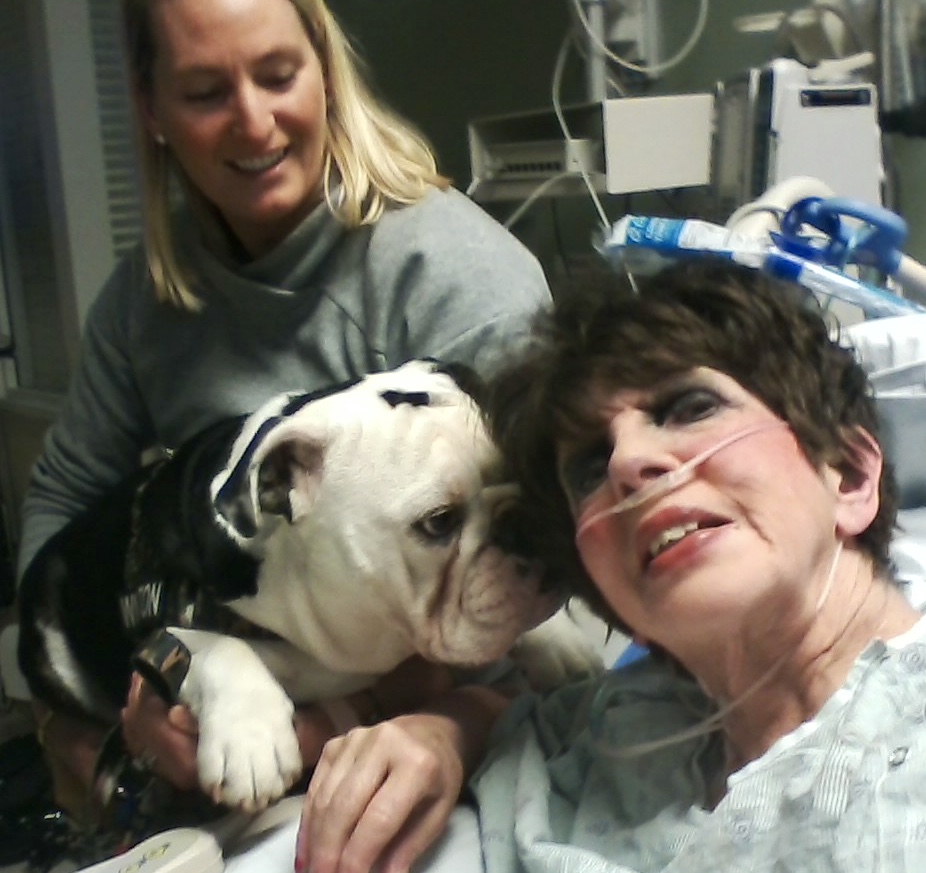
Carol E. Crain is shown in the above photo during December 2018 as a therapy dog visited Carol during her hospitalization at North Greenville Hospital, LTACH (long term acute care hospital), Travelers Rest, S.C. Carol loved dogs. This is the last photo I took of Carol, who suffered from pulmonary hypertension for six years. She passed on after our four-night stay together at Hospice House of the Carolina Foothills, Landrum, S.C. I dearly loved Carol. -- Larry Steve Crain, Carol's husband of 48 years.
See Carol's blog at carolecrain.blogspot.com.
Obituary:
Carol Ellen Williamson Crain, 71, of Taylors, S.C., died on January 11, 2019.
Born in Oakland, California., she grew up in Washington, Pennsylvania, as a daughter of Betty Lee Day and the late Edward Williamson. She was a retired teacher and a member of Sandhills Assembly of God, Southern Pines, N.C.
Also surviving are her husband, Larry Steve Crain of the home, and two daughters: Janelle Lee Smith (Terry) of Taylors, S.C., and Suzanne Crain Miller (Chad) of Raleigh, N.C.
Mrs. Crain affirmed that she “accepted Christ as her Savior” when she was four and a half years old at a “Vacation Bible School held at Broad St. Baptist Church in Washington, PA.” A 1969 Bob Jones Univ. graduate, she taught at Gateway Elementary School in Travelers Rest, S.C., before moving from Greenville, S.C., in 1988 to N.C. She last taught school at Hoffman Elementary, Richmond County, N.C. In recent years, she led inspirational book discussions and mailed letters to many, calling her letters “Envelope Hugs.” An account of her letter-writing can be found at www.carolecrain.blogspot.com. She and her husband moved from Southern Pines, N.C., to Taylors, S.C. in January 2018. After a six-year battle with pulmonary hypertension, she died peacefully at Hospice House of the Carolina Foothills, Landrum, S.C.
Funeral services will be held 12:00 p.m., Wednesday, January 16, 2019 at the Wood Mortuary (Greer, SC), conducted by Rev. Jerry Brown and Rev. Steven Sturm. Burial will follow in Hillcrest Memory Gardens.
Visitation will be held 6:00-8:00 p.m. Tuesday, January 15, 2019 at The Wood Mortuary, Greer, S.C.
The family is at the home. In lieu of flowers, memorials are suggested for Assemblies of God World Missions, 1445 N Boonville Ave., Springfield, MO 65802, or Hospice of the Carolina Foothills, P.O. Box 336, Forest City, NC 28043.
Friday, December 7, 2018
Herbert Bullock, the Preacher Who Survived Pearl Harbor
This article was published in 2003 in "The Pilot" newspaper in Southern Pines, N.C. Herbert Bullock worked at Gulistan Carpet Company in Aberdeen, N.C., at the time this article was published. He died a few years after that.
Pearl Harbor Naval Base, Hawaii – Sunday, December 7, 1941: Herbert George Bullock of Southern Pines, N.C., was there.
“We’d just come off fleet maneuvers two weeks earlier,” says Bullock, who served as a third class petty officer on the USS Raleigh.
His ship, a 7,050-ton Omaha class light cruiser which was damaged by a torpedo and near-missed by a bomb, survived the battle in which the U.S. sustained about 3,700 casualties and saw 18 ships sunk or badly damaged and 170 planes destroyed.
“We’ve been out dancing and drinking in Honolulu,” says Bullock, 82, who weighs 137 pounds and stands 5 feet-9 inches tall. He still works part time as a security guard and serves as an elder at Aberdeen’s New Hope Church of God in Christ. “We stayed in Honolulu on Friday night, and I said, ‘We’d better go back to Pearl Harbor.’”
Pearl Harbor Naval Base lies west of downtown Honolulu on Oahu Island. Bullock rode a bus to Pearl Harbor.
“Motor boats would take sailors to ships,” he says. “We got back to the ship about 9-10 p.m., Saturday night. One man went to the USS Arizona. I got to bed about 11.”
Bullock, who “had a hangover,” intended to return to shore on Sunday, but his plans changed around 7:55 a.m.
“My mother always was a praying woman; when she called, I came,” Bullock says. “Before we got hit, what woke me up was my mother calling me, ‘Herbert.’ And I heard ‘boom, boom, boom.’ I thought some big shot was coming to visit the ship. I said, ‘Let me go see what’s up.’”
Clad only in underwear, he ascended the hatch.
“We’re being attacked by the Nipponese,” an officer yelled.
“Who’s the Nipponese?” Bullock asked.
“The ‘Japs,’” the officer said.
“Everybody was running everywhere,” Bullock says. “Sirens were going; I saw 2 Zeroes flying from Diamond Head. One fired a torpedo, and I felt the jolt when it hit the middle of our ship. We closed off the damage. After that first attack, they sent another wave.”
The USS Raleigh’s commanding officer, R.E. Simons, reporting on the Dec. 7, 1941 attack, wrote: “Shortly after 0900 a glide-bombing attack came in, which met with a warm reception. Many near misses fell about the ship. Only one bomb hit.”
A bomb fell through an oil tank and pierced the skin of the ship below the water line, detonating on the harbor’s bottom, about 50 feet from the ship.
“In its flight,” Simons said, “this bomb went over the heads of the gun crew of #7 3-inch gun and also passed very close to our two large tanks containing 3,000 gallons of high-test aviation gasoline. This plane machine-gunned the ship also.
“I saw some planes shot down,” Bullock says. “Nobody died on my ship. Two Japanese suicide subs stayed right around our hospital ship. The USS Arizona went down.”
Richmond Roots
Born in Richmond, Va., on June 12, 1921, Herbert Bullock grew up “Baptist” with one older sister and a younger brother and sister.
“I believed in having fun,” Bullock says. He laughs and reminisces. “Mama said to me, ‘If you don’t stop the way you’re doing, you’re gonna die with your shoes on.’”
His father worked in a cigarette factory.
“He made a lot of Lucky Strikes,” Bullock says. “I used to smoke a lot of them.”
Bullock enjoyed bike-riding and skating and wanted to play football but couldn’t gain weight.
“I used to shine shoes,” he says. “People—mostly white people—would bring shoes for me to shine when I was 10 or 11. I even gave my mother some money.”
His mother wanted him to attend college, but he graduated from Richmond’s Armstrong High School, moved to Washington, D.C., and worked on a James River excursion boat.
“I sold food and everything on that boat,” he says. “It had bands. Cab Calloway played at times.”
The idea of “travel” attracted Bullock to the Navy. He served as a steward for officers and felt that some officers talked to him more than they did to their staff members. After Pearl Harbor, he served in the Pacific arena.
“When the war ended, I was near Okinawa, on the USS Wyndham Bay,” Bullock says.
After leaving the Navy in late 1946, he worked at the Pentagon in Washington, D.C., where he met Matilda Hadley, a Raeford, N.C., native who worked in naval research. They married and bought a home in Washington and raised twin sons.
Mother McCrae
In the early 1950s, Bullock met “Mother McCrae.”
“I used to have parties at my house,” Bullock says. “This old neighbor lady, Mrs. McCrae, talked to me about the Lord—she’d call me ‘Son’—and I tried to make her mad.
“She’d have prayer meetings at her house, but her husband drank, so I’d get him all feeling good, and he’d go home and raise hell at the meetings. Mrs. McCrae was a ‘holiness’ lady. She just got nicer. I finally told her, ‘Mother McCrae, I’m going to church with you.’”
Bullock and his wife attended McCrae’s church but sat near the back “to hide.”
“I saw people singing, praying, and enjoying the Lord,” Bullock says.
As the service ended, the minister saw Bullock and addressed him from the pulpit: “Mr. Bullock, would you like to say something?”
“Whatever this is y’all got, I’m gonna get it,” Bullock told the congregation.
Preaching and Praying
Bullock recalls that some thought he had become sick and was preparing for death.
“When I got saved and started going to church, all my friends thought I was going to die,” Bullock says. “Some of them were influenced and became ministers.”
Bullock received ordination in the Church of God in Christ in 1956 and is still a card-carrying elder in the denomination. He and his wife lived in Union, N.J., before moving to Southern Pines in the 1970s. He worked as a pastor and a chauffeur and also worked with William “Buzz” Hicks at Theatre Antiques in Southern Pines. Bullock’s wife died in 1987.
“Mr. Bullock tries to help everybody and loves people,” says Evangelist Thelma Ingram, Bullock’s pastor at New Hope Church, Aberdeen, N.C. “He prays for them and cares about souls.”
“When they attacked Pearl Harbor,” Bullock says, “it caused Americans to put aside differences and get together. We as a people—I’m talking about black and white—we ought not to be against one another.
“And the young people—they just want somebody to love them. The rest of my life I’m going to preach and pray for the young people and help them back to God. If God gives me strength, I’m going to help them. If God can fix me, he can do the same for our young people.”
Subscribe to:
Posts (Atom)